
Claire Haik, Jill Peckelun, and Lee Lovett

Give a brief description of your upcoming show. And what might have inspired it.
This show contains two main bodies of work.
The first set includes Cave, Beneath the Sinkhole, and Coastal Cave. Allowing science to inform my abstractions of natural imagery, I hope to show the hidden processes that exist beneath the visual exterior.
The inspiration for Cave and Coastal Cave came from an exploration of rock growths in the Caribbean Islands that have been continually forming for a almost a million years. Shaped by both coastal and inland waters, the terrain on these tropical islands includes gnarled and complicated rooms created at the base of the ocean cliffs and miles of collapsed caves reclaimed by the forests. For me, these images underscore how we often perceive permanence in what is transient—yet ecosystems cycle, mountains crumble, and organic matter decays.
In Beneath the Sinkhole, I fuse scientific diagrams with representational painting to emphasize the complex processes beneath the ground. Tiny streams carry grain after grain of earth, carving arterial pathways and vast subterranean caverns. After hundreds of years, these spaces cannot hold the surface. The ground drops out with no regard to what’s above it.
The second body of work includes plein air paintings from Italy and New England. In paintings such as Thicket, Back Yard Fence, and Rainy Pathway, my subjects were within or on the edge of urban developments. In Italy I looked for spaces in close proximity to famous sights but not the sights themselves. For example, Trees in the Italian Sun and Garden Wall are located next to one of the largest tourist attractions in Florence, the Basilica di San Miniato al Monte. Cliff Path is just down the beach from the bustling touristy seaside community Monteross in Cinque Terre, Italy.
I look for tiny moments of natural wildness that, for me indicate a more distinct place and time than widely renowned landmarks or cityscapes.
How have you expanded existing themes/ideas for which you are best known/or if this body of work is a great deviation from your norm, what inspired this new approach?
We often see the natural world as a mirror of our own anxieties and hopes. This imposition of our own feelings upon nature is a part of what makes us human.
When an event is dangerous, such as a wave crashing against jagged rocks, we call it harsh and cruel. When soft and docile, like a meadow filled with sunlight, nature appears serene and even benevolent.
Technology and science also alter our understanding of the underlying mechanisms governing the natural world and so change our relationship to it. As our perception of reality changes, so do our depictions of the world.
In much of my newer work, I am thinking about the similarities between scientific and artistic representation. At the root, both choose certain variables while excluding others. Artists designate how a subject is framed and which elements are included just as scientists choose the parameters of an experiment.
How an artist organizes those elements within an image—such as the shape and texture of the brush strokes or the vibrancy, contrast, and overall value of the painting—is a choice of symbolic variables which change the articulation and the interpretation of the subject.
Stylistically and/or technically, what do you hope collectors notice in your new work?
In this grouping of studio and plein air paintings, observation of nature is a catalyst for my images. However, I strive for an abstraction within my work that resonates on a deeper level than representational rendering. I emphasize color relationships and expressive shapes, distilling intricate scenes without compromising their complexity. I seek a fusion of observational painting, invention, and abstraction to impart my understanding of a subject.
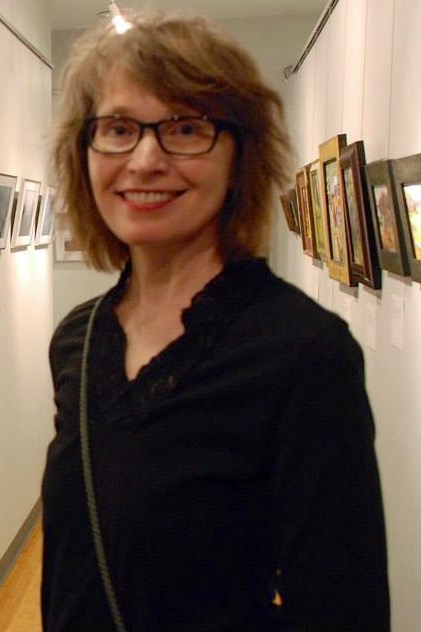 Jill Peckelun
Give a brief description of your upcoming show. And what might have inspired it.
These pieces are recent paintings I did alla prima, en plein air (at one go, on location) in Central Pennsylvania. I am always inspired by the compositions that are there for the finding out of doors. I pretty much just wander around outside until I come across something that stops me in my tracks visually and emotionally. And, then it’s a race against time…the shift of shadows in sunlight…while I do my best to portray what I see.
How have you expanded existing themes/ideas for which you are best known/or if this body of work is a great deviation from your norm, what inspired this new approach?
This body of work is part of an ongoing theme of tension between realism and abstraction. My paintings continue to evolve over time as I experiment and play as they vary between these two poles depending on the subject and my mood of the day.
Stylistically and/or technically, what do you hope collectors notice in your new work?
I hope they are aware that what looks casual is deliberate. I enjoy work that appears to be spontaneous. I paint with a lot juicy paint and direct clean brushwork. No guts, no glory. I am so pleased with these pieces. I paint prolifically. So these are some of my very best.
Add any additional info that might interest the viewer.
I love painting from life. There is such a visceral interplay between the artist and the subject when you are standing in the landscape that you are painting. You become a part of it. When I look at my work afterwards I remember the scent of the day, its heat or cold, the wind, the bugs, the sounds of birds, the music I was singing in my head.
 Lee Lovett
Give a brief description of your upcoming show. And what might have inspired it.
This group of work was inspired by my trip to Paris last May with my 17 year old daughter. It was a dream of hers to go to the Louvre and I just couldn’t find a reason to say no, I mean, who wouldn’t want to go to Paris, especially in May. We went and saw the city, the art, and the people. It was an amazing trip. One of our favorite days was taking a train to Giverny to bike out to Monet’s Gardens. I think every colored Iris was in full bloom and the gardens were the most amazing that I have ever seen. My daughter Alessandra and I actually sat in the back of Monet’s Gardens and painted for about two hours in our sketch books. So, These images were simmering in my mind all last year until I finally was able to paint them out. They run the gambit of what we saw….. the city, Notre Dame, Versailles, the River Boats along the Seine, and then of course Monet’s Gardens.
How have you expanded existing themes/ideas for which you are best known/or if this body of work is a great deviation from your norm, what inspired this new approach?
This body of work is approached similarly to past works. I love that first two hours of a painting, the time that you get lost in it and have no notion of time. I did inlay several maps into the base of the paintings…for example, Charging Forward, and Along the Seine. My florals use both palette knife and brush. I have been interested in accomplishing the start of a painting with the palette knife, and the conclusion of a painting with brushwork.
Stylistically and/or technically, what do you hope collectors notice in your new work?
I hope that viewers will feel the spontaneity of both color and brushstrokes within my work. I tried for a more contemporary look in “Monet’s Palette” by using only the palette knife. While in “The Day the Bells Rang” I wanted a painterly more traditional look and so I used only brushwork. In these paintings I wanted to capture the emotion of the days that we spent in Paris…The pure delight in being in another’s culture which was so wrapped up in Art History.